
Throughout the course of my time here at UGA, I completed a Sustainability Certificate, in which I took 17 credit hours and completed a Capstone project. This certificate centers on seven key sustainability competencies and has fully shaped my education here at UGA.
01
Anchor Course:
People, Planet, and Profit
For my anchor course, I got the opportunity to travel to Hawaii over Spring Break my sophomore year and take People, Planet and Profit. This class exceeded my expectations in every way and it taught me about a community's connection to their land, their people, their animals, their values, and their traditions.
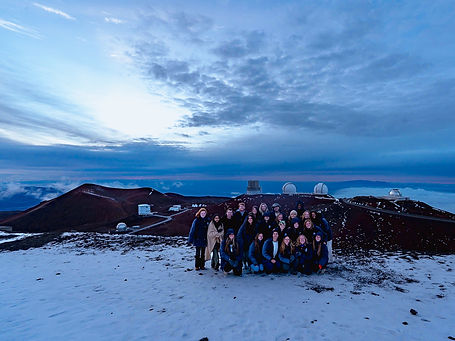
We arrived in Hilo, where we got to visit lava tree parks and their town farmers markets, traveled down to Kīlauea Hawai’i Volcanoes National Park, to hike an active volcano and learn about its ecosystem, and finished in Kona, snorkeling in protected sea habitats and going to the top of Mauna Kea. We debated the ethical principles of technology and space innovation being placed on the sacred high grounds of Mauna Kea, and debated the impact of tourism on community history preservation and sustainable initiative development. One of my biggest take-aways from this course is that there are so many living organisms and components that play such an important role in an ecosystem, and sometimes I never give myself the time to slow down and appreciate or understand each organism's role. With sustainability, I have to be able to slow down and understand all the pieces in a living system to be able to make the most positive impact through my actions and decisions. I was also incredibly moved by seeing and understanding how connected the local community was to their land. I’ve never been one to feel overly connected to one specific place, as I have a lot of love for various different cities and spaces I’ve been to in my life. With that being said, seeing first hand how hard native communities fought for the preservation of their heritage, their values, and their land restructured how I see my own land and my own space that I’m lucky enough to call home. It’s a beautiful thing to see a community come together to fight for something they love and believe in, and even on a small scale, it's incredibly inspiring to know that change and action is possible when shared passion and respect is involved. Watch the video linked in the photo above to see my reflection project!
02
Social Sphere:
Fashion Sustainability
For my Social Sphere class, I took a Fashion Sustainability elective with Professor Sara Idacavage, where I gained an in-depth understanding of sustainability within the context of the industry.

As a class, we read published journals, historical references, and opinion pieces ranging from Liz Ricketts writings on Sacrifice Zones for the OR Foundation to historical book excerpts on original garment treatments and women's expected roles in the family system. We progressed through content first debating the term sustainability and its internal contradictions and biases, then gaining a grasp on sustainable materials, manufacturing, and fast fashion, then understanding greenwashing tactics and the global secondhand trade, to finish off with circularity, degrowth economic principles, and fabric care. This general outline of content drove us through all four sustainability spheres by highlighting a multitude of complex pieces in an extremely large and interconnected system. Each class, we came prepared with discussion questions relevant to our weekly article, and debated opposing arguments brought to light in the written piece. Seeing as sustainability is a very complex topic with varying opinions and solutions, our debates regularly opened my eyes to opposing viewpoints and perspectives.
One of my favorite things we did in our class was exploring ways to promote Earth week and Fashion Revolution Day! We created advertisements and increased student enthusiasm and participation in UGA campus Earth week events by tabling at our campus center with flyers and posters educating individuals on ways they can decrease their fashion impact. For our final project, we each had a research based, individual exploration of a topic of our interest. At the current moment, I was holding a role as my sorority’s sustainability chair, and so I became heavily interested in the sorority culture within the context of sustainable fashion. We hosted our “DeFashion Exhibit” in the Georgia Museum and each presented our research projects with interactive features to a number of students, professors, community members, and loved ones. Overall, this course formulated the way I contextualize, debate, and solve sustainability problems in the fashion industry. It challenged me to think critically about fashion brands and the industry as a whole. This course created an incredible foundation for me to target areas of improvement within the fashion industry, while also guiding me into a direction of the industry I could envision a career in.
03
Economic Sphere:
Global Sourcing
For my economic sphere, I took TXMI 4260, Global Sourcing. During this semester, we learned about the history of sourcing in the context of the fashion industry, the mechanics of the global supply chain, along with the future directions of the fashion industry and what sourcing will look like within the next few years.

We dove into apparel manufacturing processes, important legislation that impacts trade and global shipping, trade regulations, off shoring, exchange rates and global partnerships, customs and border protection, HTS textile and apparel product classifications, sourcing strategies such as Cut Make Trim, socially responsible sourcing, and sustainability within the supply chain, to name a few main topics. This course was the foundation for my understanding of sourcing as a key role of the fashion industry. Gaining a base knowledge of sourcing and the supply chain within the context of our economic and political state was extremely beneficial to my development as an intended sustainability professional within the apparel sector. My global perspective was widened and my understanding of manufacturing practices broadened my skillset, opening my eyes to different careers that I hadn’t once known existed. After this class, my interest in Product Development, Sourcing, and Production increased significantly.
An understanding of current sourcing practices within the industry and common supply chain practices allows me the opportunity to identify gaps within the industry and problem solve ways that these practices can be improved to become more sustainable on a wider scale. We spent time discussing sustainability content such as The Higg Index, the Sustainability Apparel Coalition, and B Corp, which was an introduction into corporate sustainable standardization. Understanding how impactful trade agreements, tariffs, legislation, HTS classifications, and costing strategies can be on a single garment really puts into perspective how complex this system is and how many very small triggers can greatly impact a company, a customer, or the market in general. The apparel industry is volatile and one main thing I learned from this class is that adaptability is key. Big players within the industry are able to adapt very quickly to information. Successful businesses perfectly blend consistency with experimentation, and growth comes from close attention to the direction of our political and economic environment. Overall, the course introduced me to concepts, terminology, and economic strategy that has completely shaped the way I think of my career, the way a garment is made, and the way the industry works as a whole.
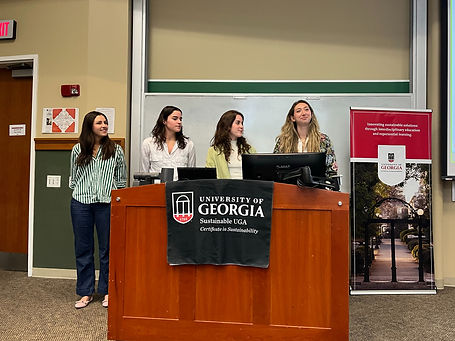
The main deliverable we worked towards in this was a group project creating a business proposal, where we learned to invest in other student project businesses throughout the span of about 8 project presentations to our investors. Here are a few key photos from our presentations!
04
First Seminar
During the fall semester of my senior year at UGA, I took SUST 4200, our sustainability certificates’ seminar course. This interdisciplinary class consisted entirely of sustainability certificate students, unlike any sphere course I had taken in the past. The course's main goal was to introduce and guide students to better understand and utilize the main sustainability competencies: Systems Thinking, Anticipatory Competency, Strategic Competency, Normative Competency, Integrative Problem Solving Competency, Intrapersonal Competency, and the Collaboration Competency.

Each week, we analyzed and discussed relevant articles, research, ideas, and industry and local professionals that connected to each specific sustainability competency. Each week, we also had guest speakers come in from different professions and career paths to showcase a different perspective in the field of sustainability. We heard from Claudia Brown with the Centers for Disease Control and Prevention, Andrew Bohenko with the Mercedes-Benz Stadium Sustainability team, Samantha Siragusa with UPS, Tawana Maddox with the Athens Land Trust, and Dr. Christopher Weatherly with the UGA School of Social Work, to name a few. We also participated in class activities that further deepened our understanding of our sustainability competencies in different contexts, by creating systems maps of UGA and establishing our own Bottle Bill policies for Georgia, among other groupwork. This course not only introduced me to the wide variety of career opportunities and sustainability entry points that our job market has to offer, but it also created a space where sustainable action felt attainable, like every small decision can truly lead us towards a more sustainable future. Understanding how many incredible individuals are out there fighting to make the world a better place helped me find my place, working towards sustainability within the fashion industry. It inspired me to pursue sustainable action in fields I previously felt uneducated on and to incorporate the sustainability framework competencies into my daily life. Now, I have an incredible tool to utilize, resort back to, and grow from as I become more experienced applying myself to these different competencies, for my career pursuits, my personal life, and my overall sustainability goals.
05
Second Seminar
During my time in my second sustainability seminar class, I got the opportunity to dive deeper into the 7 main competencies that make up the framework of our sustainability curriculum. During my first seminar class, my focus was mainly on learning and comprehending the competencies, identifying differences between them, and connecting them to real-world examples. However, during my second seminar class, I was able to take this a step further. With a deeper understanding of the competencies came a level of both natural integration and intentional application into my day-to-day life and project work.

During this semester, in connection to my work with my sustainability certificate and the Fashion Merchandising department, I had two incredible opportunities to travel for sustainability initiatives. At the beginning of the year, I was selected for a Fashion X:Change program through Berlin Fashion Week and the Atlanta Sustainable Fashion Week. For this project, I created a zero waste design for an editorial photo and film exhibition I directed, inspired by sustainability storytelling. I collaborated across borders to pursue similar passions while discovering cultural differences along the way. Later in the year, I, alongside my capstone project partner and friend, Ruby Gagnon, got a scholarship to attend the ChangeNow Sustainability Conference at the Grand Palais in Paris. During this conference, we were able to gain a global perspective on sustainability challenges and solutions, while deepening our understanding of collective action, sustainability legislature, fashion innovation, scientific developments, technology advancements, and much more.
In an attempt to pull together my learnings from both of these global sustainability initiatives I was lucky enough to participate in, I want to hit on two main ideas. First of all, global perspectives help us put our local work in context. When we understand what sustainability initiatives other countries are working towards and what other countries may need, we can scale their models and needs into a local space in order to build sustainable infrastructure resiliency. Second of all, collaboration is key. Knowledge is power, and sharing knowledge, resources, innovation, and connections is what transitions something good into something with long lasting impact. What I’ve personally come to understand from surrounding myself with the global sustainability community and by my involvement in the UGA sustainability certificate program is that people want to help and people want to learn. There is no shortage of individuals out there fighting the fight for sustainable change, and every initiative is a step in the right direction. Always ask, always try, always be open minded, and always fight for what's good in this world.
06
Capstone
During the fall semester of my senior year at UGA, I had the privilege of taking a capstone class to wrap up my sustainability certificate. Over the summer, we had a select group of projects we could choose from, however I knew from the start of my time working through the sustainability certificate that I wanted to carve a path for fashion merchandising majors to see really incredible industry opportunities within the sustainability capstone. Therefore, while I was working with American Eagle Outfitters as a Concept Design Intern over the summer, I connected with our VP of Sustainability, Michelle Terry, and proposed a brand new consulting partnership between UGA Sustainability students and AEO for a capstone project, which we made possible, with the immense support from Tyra Byers, our Sustainability Certificate Director.
This project then became the AEO Design for Sustainability Training Modules, a set of training modules tailored to apparel designers in the AEO corporate offices, that they can utilize as a resource, a refresher, and overall inspiration to encourage sustainable decision making in their daily tasks and personal life. Over the span of the semester, the project deliverables took many different shapes and evolved over time into four training videos. The first video being a Sustainability Refresher for All AEO employees, to be displayed during their REAL GOOD Refresher meetings, following with three Designer Specific training modules and consecutive engaging quiz questions to be implemented on the AEO employee training platform.
These modules included extensive research into the most effective and approachable ways to convey the concept of sustainability, the idea of sustainability within the context of the fashion industry, the impact of apparel production through the lens of the three main pillars of sustainability (Environmental, Economic, and Social/Cultural), an in depth exploration of AEO’s current initiatives in each sustainability pillar, and relevant actionable items that AEO employees can currently prioritize to proactively engage in sustainable discourse. The modules are presented in a 3-5 minute video format with engaging graphics and a voiceover of a pre-written script, including a follow up short quiz to measure our designers understanding of the content and to further solidify the material into their repertoire of knowledge.
I learned so much throughout the process of this capstone project, and I truly feel my understanding of both apparel design in the fashion industry as well as sustainability education has expanded immensely. During this semester, I gained better insight as to how the apparel industry works through a systems thinking approach. By connecting not only with our project partners, but designers as well, allowed my team and I to get the full picture of what the process looks like for a garment in widescale production. By analyzing the whole system and understanding all the key roles that play into the making of a product, we were then able to identify areas of interference for sustainable solutions that could create lasting positive change to influence the system as a whole. We also utilized normative thinking to gain a deeper understanding of our company’s target demographic. To understand the customer and their values, beliefs, and desires relative to sustainability helps us to better address those needs from the designer's perspective. We realized that each customer comes from different backgrounds, has a different set of needs, experiences shifts in cultural expression and trends differently, and has varied levels of interest in sustainability, therefore, the designer has a lot of different needs to try to meet, and that can be overwhelming. By using the strategic competency, we were able to establish a line of reasoning to guide designers into a comfortable space where sustainable action isn’t overwhelming. They already have a lot of needs to address and sustainability adds to their plate. Sustainability is something that comes from within, it's a personal choice to place extra effort into sustainable action. Unfortunately, it's unlikely in this current economy for employees whose jobs aren’t directly in line with sustainability to get financially compensated for extra sustainable action they pursue. Therefore, we had to be strategic in empowering the designers to feel like they already have a community pursuing sustainable action, and that sustainability comes in all shapes and sizes, including things that AEO/ the designers themselves may already be doing! The work is there, we just have to keep fighting for action to create positive change.
This capstone project was a testament to my passion for fashion design, sustainability, group work, education, communication, and storytelling. This taught me so much about myself as an individual, as well as sustainable problem solving within the context of the fashion industry and my career path. The process was a challenge, navigating a new project that had never been done before and required a lot of reworking, however, it was extremely rewarding to pioneer a capstone project with a global fashion company like AEO. It’s inspiring to know that fashion companies, like AEO, are continuing to strive for sustainable solutions, and are actively supporting young talent with their passions. These training modules have the ability to set a precedent in the industry, as sustainability training per specific role is extremely time consuming and not very common currently. However, with the resources we have established and the ease in which our resources can be substituted to target other roles in the company, we have worked towards the start of something really impactful, scaleable, and repeatable.